
JEE Main 2025 Apr 2 Shift 1, Chemistry Q18: Properties of Alkynes
Consider the following compound (X)
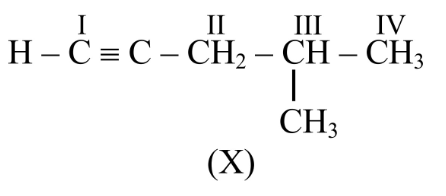
The most stable and least stable carbon radicals, respectively, produced by homolytic cleavage of corresponding C – H bond are :
- A
II, IV
- B
III, II
- C
I, IV
- D
II, I
Each position generates a different carbon radical when its C–H bond breaks homolytically. Their stability is ranked by hyperconjugation and (especially) resonance/conjugation with the adjacent triple bond:
Position II: The radical sits on the carbon adjacent to the -system. The unpaired electron is stabilised by resonance/conjugation with the triple bond (propargyl-type), making this the most stable.
Position III: Propargylic-type radical (one bond from the triple bond) — moderately stable.
Position IV: Tertiary (or branched secondary) alkyl radical — stabilised mainly by hyperconjugation.
Position I: Acetylenic radical on the terminal -carbon. No resonance, no hyperconjugation, and the orbital holds the unpaired electron tightly close to the nucleus — this is the least stable.
Most stable = II, least stable = I, which is option (4).
Concept behind this question
Properties of AlkynesNotes, formulas and examples →More previous year questions on Properties of Alkynes
Practice more Chemistry
Concept-wise practice with instant solutions on Fundamenthol.
Start practicing →