
JEE Main 2025 Apr 4 Shift 2, Chemistry Q10: Mechanism of Some Important Reactions
A toxic compound "A" when reacted with NaCN in aqueous acidic medium yields an edible cooking component and food preservative 'B'. "B" is converted to "C" by diborane and can be used as an additive to petrol to reduce emission. "C" upon reaction with oleum at 140°C yields an inhalable anesthetic "D". Identify "A", "B", "C" and "D", respectively.
- A
Methanol; formaldehyde; methyl chloride; chloroform
- B
Ethanol; acetonitrile; ethylamine; ethylene
- C
Methanol; acetic acid; ethanol; diethyl ether
- D
Acetaldehyde; 2-hydroxypropanoic acid; propanoic acid; dipropyl ether
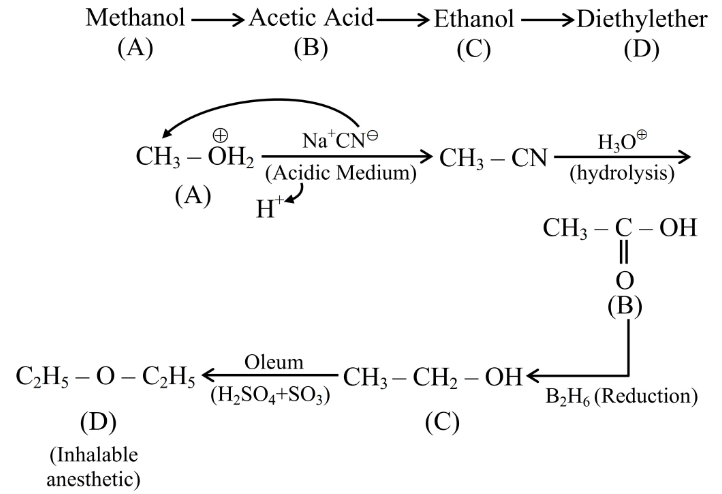
Follow the clues step by step.
A B: A toxic compound that, in acidic medium with NaCN, gives an edible food preservative. Methanol () is protonated to give , which is displaced by to form . Acidic hydrolysis converts into acetic acid, () — a common food preservative.
B C: Diborane () reduces carboxylic acids cleanly to primary alcohols. Acetic acid is reduced to ethanol, (), which is widely used as a petrol additive.
C D: Ethanol with oleum (conc. ) at undergoes intermolecular dehydration to diethyl ether, (), historically used as an inhalable anaesthetic.
A = methanol, B = acetic acid, C = ethanol, D = diethyl ether.
Concept behind this question
Mechanism of Some Important ReactionsNotes, formulas and examples →More previous year questions on Mechanism of Some Important Reactions
Practice more Chemistry
Concept-wise practice with instant solutions on Fundamenthol.
Start practicing →