
JEE Main 2025 Jan 28 Shift 1, Chemistry Q8: Mechanism of Some Important Reactions
A molecule ("P") on treatment with acid undergoes rearrangement and gives ("Q"). ("Q") on ozonolysis followed by reflux under alkaline condition gives ("R"). The structure of ("R") is given below :
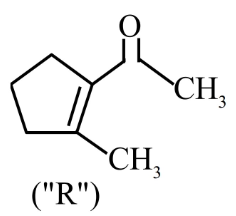
The structure of ("P") is
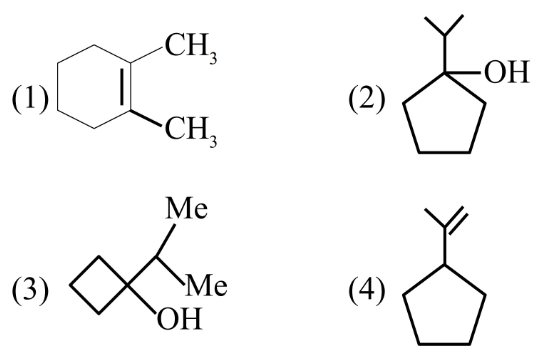
- A
1
- B
2
- C
3
- D
4
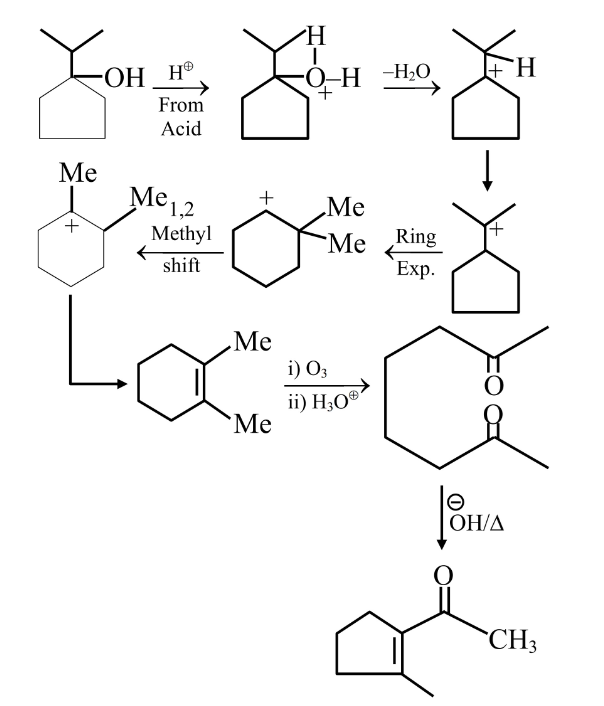
The reasoning runs as follows.
Step 1 — Acid-catalysed rearrangement of P to Q. Protonation of the hydroxyl in 1-isopropylcyclopentan-1-ol and loss of water gives a tertiary carbocation on the cyclopentane ring. A ring-expansion (alkyl shift) converts the 5-membered cation into a stabilised 6-membered carbocation. A 1,2-methyl shift followed by loss of produces a substituted cyclohexene bearing two methyl groups, which is compound Q.
Step 2 — Ozonolysis of Q. Cleaving the cyclohexene double bond with followed by reductive work-up (Zn / HO) opens the ring to give an acyclic 1,6-dicarbonyl (a keto-aldehyde with appropriate methyl substitution).
Step 3 — Intramolecular aldol under alkaline reflux. The dicarbonyl undergoes an intramolecular aldol-condensation; dehydration leaves a five-membered -unsaturated ketone, which matches R: 1-acetyl-2-methylcyclopent-1-ene.
Concept behind this question
Mechanism of Some Important ReactionsNotes, formulas and examples →More previous year questions on Mechanism of Some Important Reactions
Practice more Chemistry
Concept-wise practice with instant solutions on Fundamenthol.
Start practicing →