
JEE Main 2025 Apr 8 Shift 2, Chemistry Q12: Preparation of Ether
Which one of the following reactions will not lead to the desired ether formation in major proportion?
(iso-Bu isobutyl, sec-Bu sec-butyl, nPr n-propyl, tert-butyl, Et ethyl)
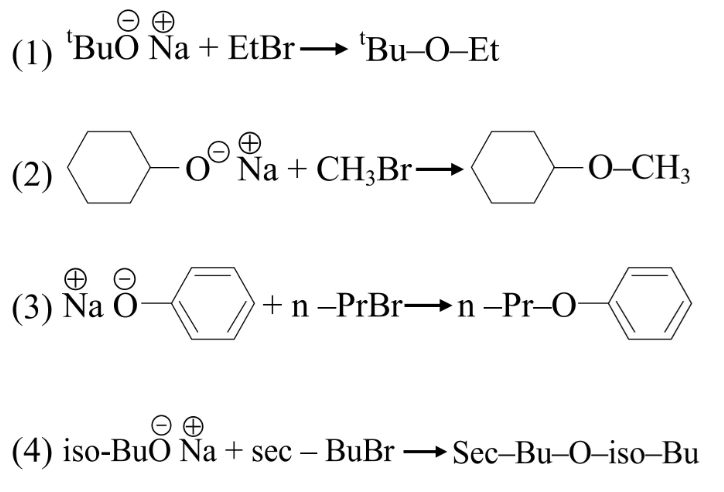
- A
1
- B
2
- C
3
- D
4
Step 1: Principle of Williamson Ether Synthesis
Williamson ether synthesis proceeds via an reaction between an alkoxide (or phenoxide) and an unhindered alkyl halide.
Step 2: Analyse Option (4)
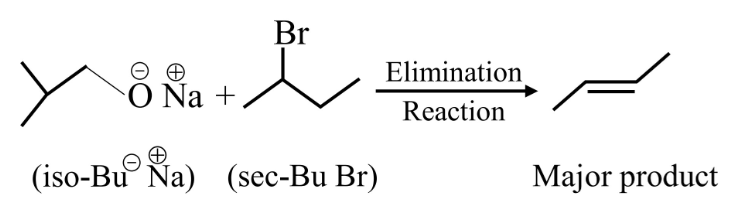
In option (4), sec-butyl bromide is a secondary alkyl halide and the nucleophile is the bulky iso-butoxide ion.
This sterically hindered combination makes attack difficult. Instead, the bulky base preferentially removes a -hydrogen, leading to E2 elimination.
Step 3: Other Options
The remaining combinations involve either a methyl/primary alkyl halide or a less hindered nucleophile, making substitution the major reaction and forming the desired ether.
Conclusion
Only option (4) predominantly undergoes E2 elimination instead of ether formation.
Concept behind this question
Preparation of EtherNotes, formulas and examples →More previous year questions on Preparation of Ether
Practice more Chemistry
Concept-wise practice with instant solutions on Fundamenthol.
Start practicing →