
JEE Main 2025 Jan 23 Shift 1, Physics Q11: Coulomb's Law And Electric Field
A point particle of charge Q is located at P along the axis of an electric dipole 1 at a distance as shown in the figure. The point P is also on the equatorial plane of a second electric dipole 2 at a distance . The dipoles are made of opposite charge separated by a distance . For the charge particle at P not to experience any net force, which of the following correctly describes the situation?
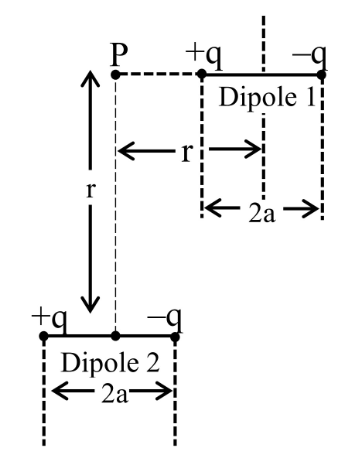
- A
- B
- C
- D
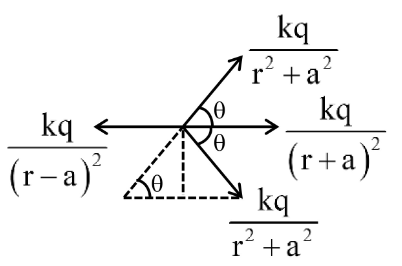
For zero net force on Q at P, the axial field from Dipole 1 must cancel the equatorial field from Dipole 2 at the same point.
Axial field of Dipole 1 (taking P at distance from the dipole centre along its axis): , which simplifies to .
Equatorial field of Dipole 2 at distance : .
Setting and cancelling :
.
Squaring and rearranging leads to a transcendental relation:
$ \dfrac{4r^2}{(r^2-a^2)^4} = \dfrac{1}{(r^2+a^2)^3} $
$ \Rightarrow 4r^2(r^2+a^2)^3 = (r^2-a^2)^4 $
$ \Rightarrow 4r^8 \left( 1+\dfrac{a^2}{r^2} \right)^3 = r^8 \left( 1-\dfrac{a^2}{r^2} \right)^4 $
$ \Rightarrow 4 \left( 1+\dfrac{a^2}{r^2} \right)^3 = \left( 1-\dfrac{a^2}{r^2} \right)^4 $
Numerical solution yields .Note: From exam point of view, it is better to put the values of a/r from the options and check in which case LHS is more close to RHS.
Concept behind this question
Coulomb's Law And Electric FieldNotes, formulas and examples →More previous year questions on Coulomb's Law And Electric Field
Practice more Physics
Concept-wise practice with instant solutions on Fundamenthol.
Start practicing →