
JEE Main 2026 Jan 22 Shift 1, Chemistry Q16: Diazonium Salt
‘A’ is a neutral organic compound (M.F : ). On treatment with aqueous , ‘A’ forms a compound ‘B’ which is soluble in dilute acid. ‘B’ on treatment with aqueous produces a compound ‘C’ which on treatment with CuCN/NaCN produces ‘D’. Hydrolysis of ‘D’ produces ‘E’ which is also obtainable from the hydrolysis of ‘A’. ‘E’ on treatment with acidified produces ‘F’. ‘F’ contains two different types of hydrogen atoms. The structure of ‘A’ is
- A
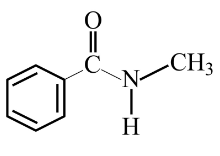
- B
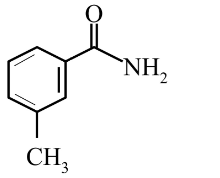
- C
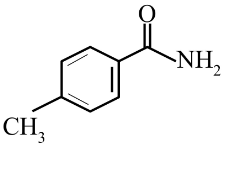
- D
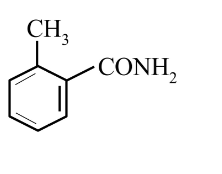
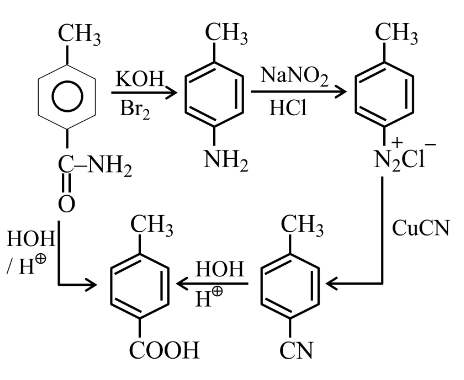
Trace the sequence. ‘A’ () treated with undergoes the Hofmann bromamide degradation, so ‘A’ must be a primary amide , and ‘B’ is the corresponding primary amine (basic, soluble in dilute acid).
‘B’ + at 0–5 °C gives the aryldiazonium salt ‘C’; Sandmeyer with CuCN gives the aryl nitrile ‘D’; hydrolysis gives the carboxylic acid ‘E’. The fact that ‘E’ is also obtained from direct hydrolysis of the amide ‘A’ confirms the relabelling: tolyl group.
So ‘A’ is methyl-substituted benzamide (). The placement (ortho/meta/para) is fixed by the last clue: ‘F’ (from oxidation of toluic acid ‘E’) is benzene dicarboxylic acid with two types of hydrogen.
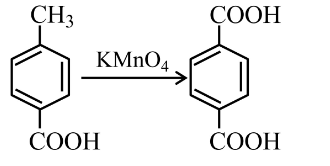
If A is para: E = p-toluic acid → F = terephthalic acid (1,4-benzene dicarboxylic acid). The four aromatic H’s are all equivalent by symmetry; the two COOH protons are equivalent to each other — so 2 distinct types of H. Matches.
If A is ortho: F = phthalic acid (1,2-benzene dicarboxylic acid). Aromatic ring has H’s at 3=6 and 4=5 (two types) plus COOH H — that’s 3 distinct types. Doesn’t match.
If A is meta: F = isophthalic acid (1,3-benzene dicarboxylic acid). Ring H’s at 2 (unique), 4=6, and 5 — three aromatic types plus COOH = 4 types. Doesn’t match.
Therefore ‘A’ is 4-methylbenzamide (p-toluamide), option (3).
Concept behind this question
Diazonium Salt Notes, formulas and examples →More previous year questions on Diazonium Salt
Practice more Chemistry
Concept-wise practice with instant solutions on Fundamenthol.
Start practicing →