
JEE Main 2026 Jan 28 Shift 1, Chemistry Q8: Properties and Important Reactions of Aldehydes & Ketones
Given below are two statements for the following reaction sequence.
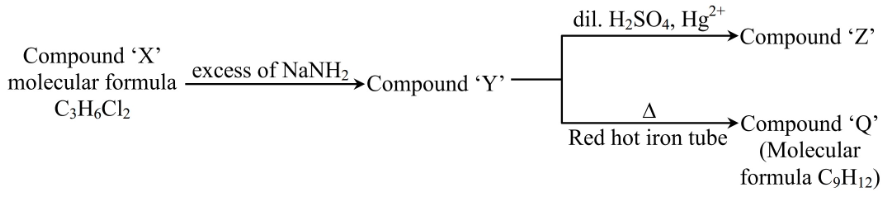
Statement I: Compound 'Z' will give yellow precipitate with NaOI.
Statement II: Compound 'Q' has two different types of 'H' atoms (aromatic : aliphatic) in the ratio 1 : 3.
In the light of the above statements, choose the correct answer from the option given below:
- A
Statement I is true but Statement II is false
- B
Both Statement I and Statement II are true
- C
Statement I is false but Statement II is true
- D
Both Statement I and Statement II are false
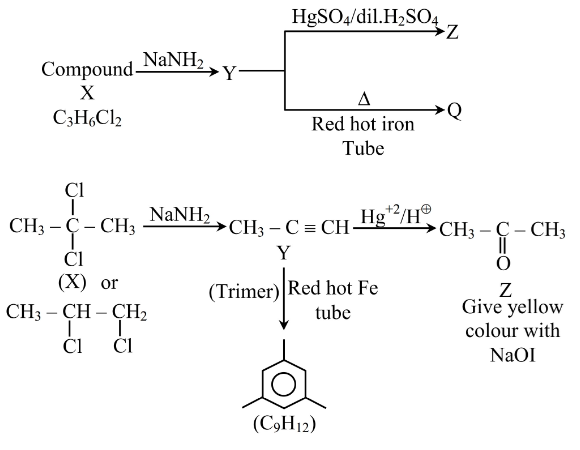
X (CHCl) is a geminal dichloride (e.g. 2,2-dichloropropane analogue with the third carbon bearing dichloride); NaNH (excess) performs double dehydrohalogenation to give propyne (Y is methylacetylene, CH-CCH).
Statement I: Y + dil. HSO/Hg (Kucherov / Markovnikov hydration of a terminal alkyne) gives propan-2-one (acetone, CHCOCH), Z. Acetone is a methyl ketone, which gives a yellow iodoform precipitate (CHI) on treatment with NaOI. True.
Statement II: Three molecules of propyne cyclotrimerise over red-hot iron tube to give mesitylene (1,3,5-trimethylbenzene), Q (CH). It has 3 equivalent aromatic Hs and 9 equivalent methyl Hs, so the aromatic : aliphatic H ratio is 3 : 9 = 1 : 3. True.
Both statements are true. Option (2).
Concept behind this question
Properties and Important Reactions of Aldehydes & Ketones Notes, formulas and examples →More previous year questions on Properties and Important Reactions of Aldehydes & Ketones
Practice more Chemistry
Concept-wise practice with instant solutions on Fundamenthol.
Start practicing →