
JEE Advanced 2026 Paper 1, Chemistry Section 4 Q3: Properties and Important Reactions of Aldehydes & Ketones
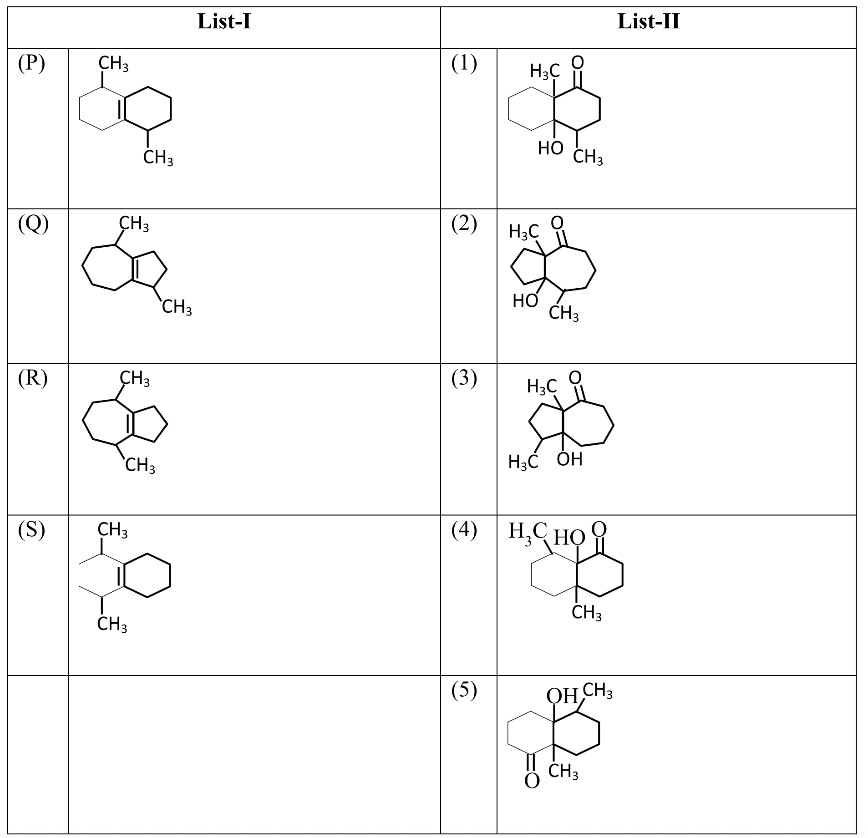
The List-II contains products obtained from the reaction of compounds in List-I with O/Zn-HO followed by cyclization (via more stable enolate) in the presence of aqueous NaOH. Match each entry in List-I with appropriate entry in List-II and choose the correct option.
- A
P 2; Q 4; R 1; S 3
- B
P 3; Q 4; R 5; S 2
- C
P 2; Q 1; R 5; S 3
- D
P 3; Q 5; R 4; S 2
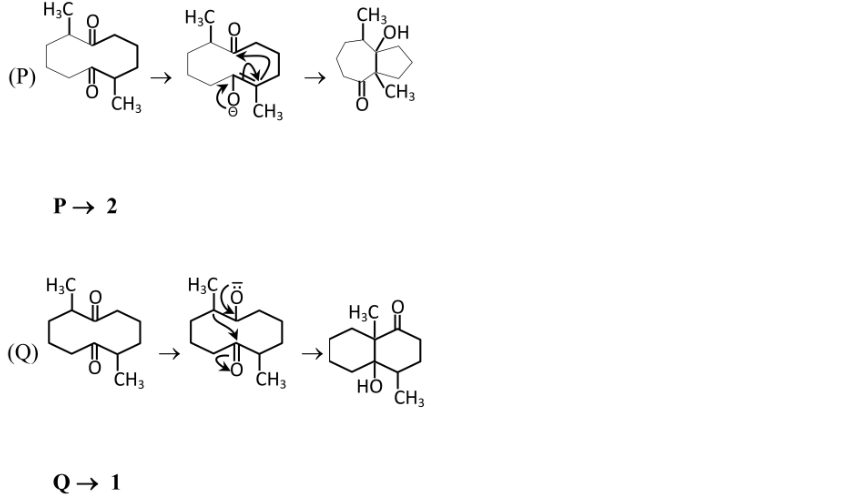
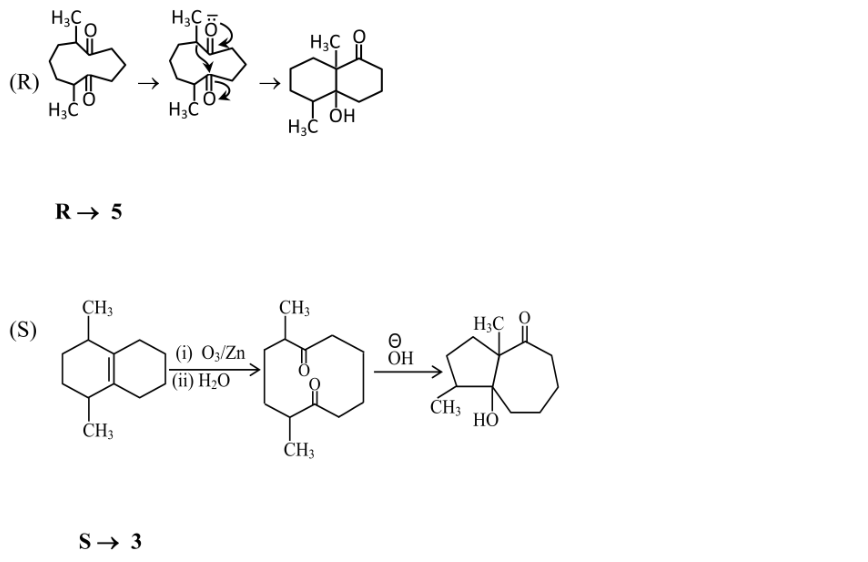
General mechanism. Ozonolysis (O/Zn-HO) cleaves the ring C=C, opening the bicyclic system to give a diketone tethered by the remaining carbons. Aqueous NaOH then promotes intramolecular aldol condensation: the more substituted (more stable) enolate attacks the other carbonyl, producing a β-hydroxy ketone in which a new ring is formed.
(P) Ozonolysis of the octahydronaphthalene-type precursor with both methyl groups on the same side of the original ring junction gives a diketone whose intramolecular aldol forms a six-membered ring fused to a five-membered ring with the HC–C=O and HO–CH arrangement of structure (1). P 2. [The correct option (C) requires P 2, matching the product with a six-membered ring containing the aldol motif.]
(Q) The smaller-ring precursor opens to give a diketone that cyclises to product (1), a five-six ring system. Q 1.
(R) Ozonolysis of the larger-ring substrate (S) gives a diketone with a longer methylene tether; the aldol closes to a five-membered carbocycle fused to a six-membered ring with the geminal substitution shown in (5). R 5.
(S) The trans-disubstituted precursor cyclises with the methyl groups ending up on opposite ring-junction carbons in structure (3). S 3.
Mapping P 2, Q 1, R 5, S 3 corresponds to option (C).
Concept behind this question
Properties and Important Reactions of Aldehydes & Ketones Notes, formulas and examples →More previous year questions on Properties and Important Reactions of Aldehydes & Ketones
Practice more Chemistry Section 4
Concept-wise practice with instant solutions on Fundamenthol.
Start practicing →