
JEE Main 2025 Apr 4 Shift 1, Chemistry Q4: Properties and Important Reactions of Aldehydes & Ketones
Aldol condensation is a popular and classical method to prepare -unsaturated carbonyl compounds. This reaction can be both intermolecular and intramolecular. Predict which one of the following is not a product of intramolecular aldol condensation ?
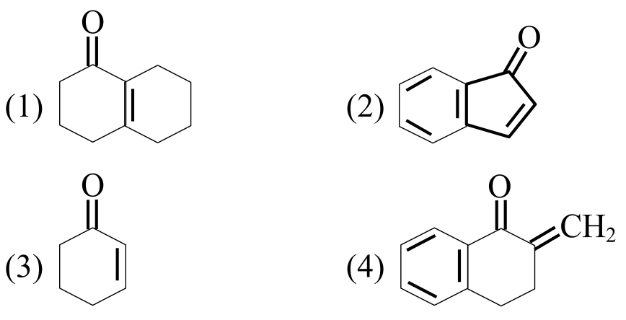
- A
1
- B
2
- C
3
- D
4
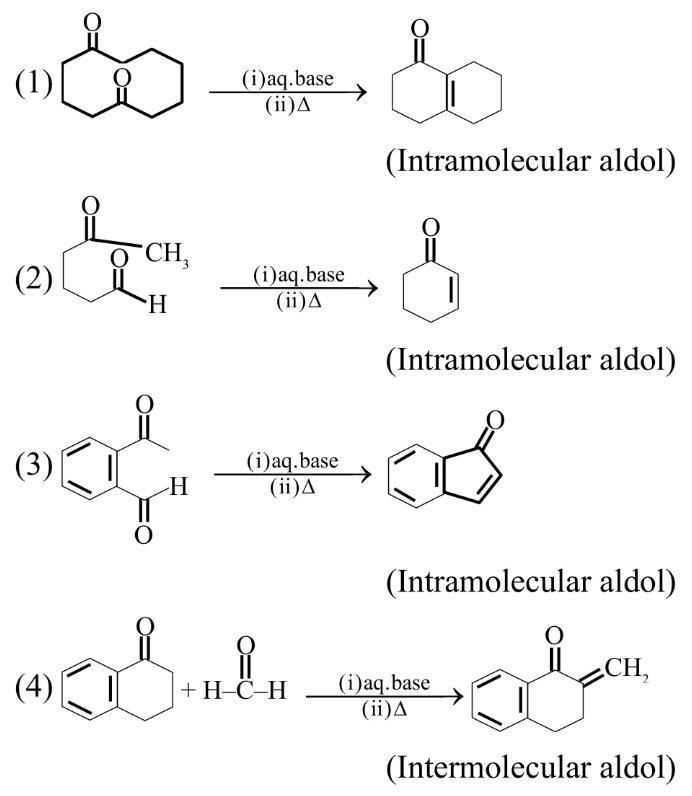
An intramolecular aldol condensation requires two carbonyl groups in the same molecule, separated by enough carbons (typically a 1,5- or 1,6-dicarbonyl) so that the enolate of one can attack the other and form a 5- or 6-membered ring with an internal -unsaturated enone after dehydration.
Options (1), (2), and (3) all arise from intramolecular aldol condensations of suitable diketo or keto-aldehyde precursors. Each product contains an endocyclic C=C conjugated with the ring C=O — the hallmark of an aldol condensation product.
Option (4), in contrast, bears an exocyclic =CH on the carbon to the carbonyl. Such an exocyclic methylene comes from a crossed (intermolecular) aldol condensation of a cyclic ketone with formaldehyde (HCHO), since formaldehyde has no -hydrogens of its own. It is not an intramolecular aldol product.
The correct answer is option (4).
Concept behind this question
Properties and Important Reactions of Aldehydes & Ketones Notes, formulas and examples →More previous year questions on Properties and Important Reactions of Aldehydes & Ketones
Practice more Chemistry
Concept-wise practice with instant solutions on Fundamenthol.
Start practicing →