
JEE Advanced 2024 Paper 1, Chemistry Section 1 Q4: Isomerism In Co-ordination Compounds
Among the following options, select the option in which each complex in Set-I shows geometrical isomerism and the two complexes in Set-II are ionization isomers of each other.
[en = HNCHCHNH]
- A
Set-I: [Ni(CO)] and [PdCl(PPh)]
Set-II: [Co(NH)Cl]SO and [Co(NH)(SO)]Cl - B
Set-I: [Co(en)(NH)Cl] and [PdCl(PPh)]
Set-II: [Co(NH)][Cr(CN)] and [Cr(NH)][Co(CN)] - C
Set-I: [Co(NH)(NO)] and [Co(en)Cl]
Set-II: [Co(NH)Cl]SO and [Co(NH)(SO)]Cl - D
Set-I: [Cr(NH)Cl]Cl and [Co(en)(NH)Cl]
Set-II: [Cr(HO)]Cl and [Cr(HO)Cl]ClHO
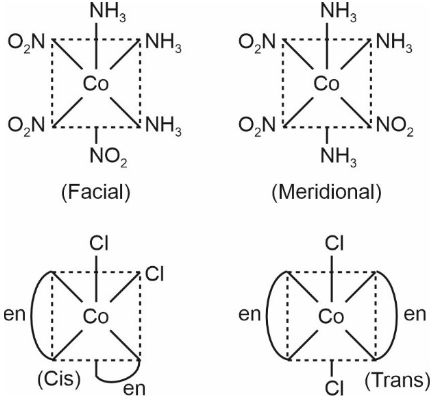
Set-I check (geometrical isomerism in each complex):
For option (C): [Co(NH)(NO)] is an octahedral type complex and exhibits facial/meridional (fac/mer) isomerism. [Co(en)Cl] is an octahedral type and exhibits cis/trans isomerism. Both show geometrical isomerism.
Option (A) fails because [Ni(CO)] is tetrahedral with four identical ligands and shows no geometrical isomerism.
Option (B): [Co(en)(NH)Cl] does show GI, but the Set-II pair are coordination isomers (cation and anion exchanging metals), not ionization isomers.
Option (D): [Cr(NH)Cl]Cl has only one stereoisomer (no GI), and the Set-II pair are hydrate (solvate) isomers, not ionisation.
Set-II check (ionisation isomers):
For option (C): [Co(NH)Cl]SO ionises to release SO as the counter-ion, while [Co(NH)(SO)]Cl releases Cl. They swap the ligand inside the sphere with the counter-ion outside, which is the defining feature of ionisation isomerism.
Option (C) is correct.
Concept behind this question
Isomerism In Co-ordination CompoundsNotes, formulas and examples →More previous year questions on Isomerism In Co-ordination Compounds
Practice more Chemistry Section 1
Concept-wise practice with instant solutions on Fundamenthol.
Start practicing →