
JEE Advanced 2024 Paper 1, Chemistry Section 3 Q3: Properties and Important Reactions of Aldehydes & Ketones
Complete reaction of acetaldehyde with excess formaldehyde, upon heating with conc. NaOH solution, gives P and Q. Compound P does not give Tollens' test, whereas Q on acidification gives positive Tollens' test. Treatment of P with excess cyclohexanone in the presence of catalytic amount of -toluenesulfonic acid (PTSA) gives product R.
Sum of the number of methylene groups (-CH-) and oxygen atoms in R is____.
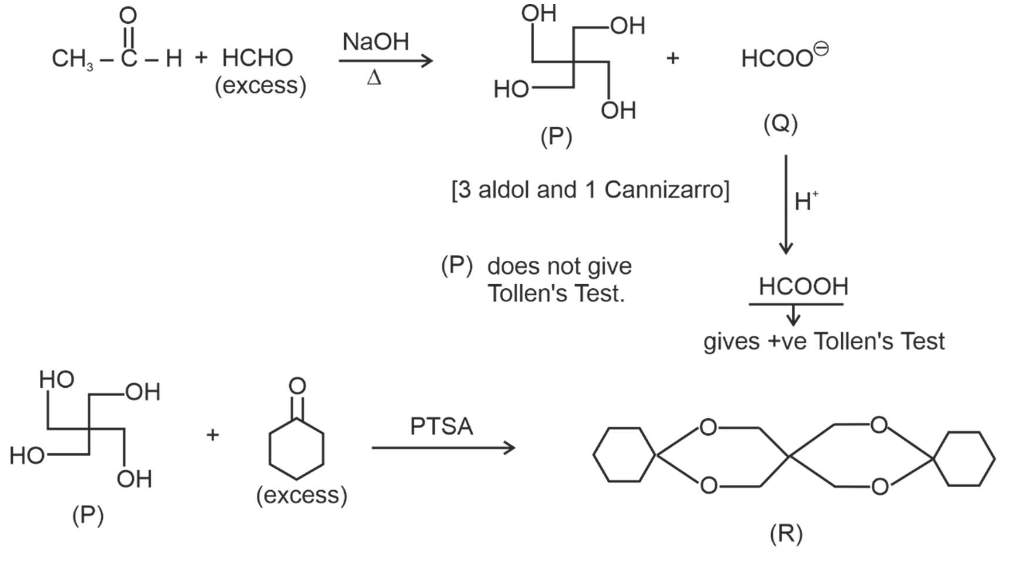
Acetaldehyde (CHCHO) has three -hydrogens. With excess HCHO under conc. NaOH, all three undergo crossed aldol with formaldehyde, then the resulting trihydroxy-aldehyde (lacking -H) undergoes a crossed Cannizzaro with another HCHO. The net result is pentaerythritol (compound P) along with sodium formate, which on acidification (Q) gives HCOOH (positive Tollens' test). Pentaerythritol itself has no -CHO group, so P is Tollens'-negative.
Pentaerythritol has 4 hydroxyl groups and 4 -CHOH arms. With excess cyclohexanone under PTSA, each pair of adjacent -OH groups condenses with one cyclohexanone to form a cyclic ketal. Since pentaerythritol's four -OH groups pair up, two cyclic 1,3-dioxane ketals are formed bridging the central carbon, giving the bis-spiro ketal R.
Counting in R (the bis-spiro ketal of pentaerythritol with two cyclohexanone units):
Methylene (-CH-) groups: 4 from the pentaerythritol arms (each -CH-O-) plus 5 each from the two cyclohexane rings (each cyclohexanone contributes 5 ring CH after ketal formation) .
Oxygen atoms: 2 per cyclic ketal 2 ketals .
Total .
Concept behind this question
Properties and Important Reactions of Aldehydes & Ketones Notes, formulas and examples →More previous year questions on Properties and Important Reactions of Aldehydes & Ketones
Practice more Chemistry Section 3
Concept-wise practice with instant solutions on Fundamenthol.
Start practicing →