
JEE Advanced 2024 Paper 1, Chemistry Section 4 Q1: Vapour Pressure Of A Solution
In a conductometric titration, small volume of titrant of higher concentration is added stepwise to a larger volume of titrate of much lower concentration, and the conductance is measured after each addition.
The limiting ionic conductivity () values (in mS m mol) for different ions in aqueous solutions are given below:
| Ions | Ag | K | Na | H | NO | Cl | SO | OH | CHCOO |
|---|---|---|---|---|---|---|---|---|---|
| 6.2 | 7.4 | 5.0 | 35.0 | 7.2 | 7.6 | 16.0 | 19.9 | 4.1 |
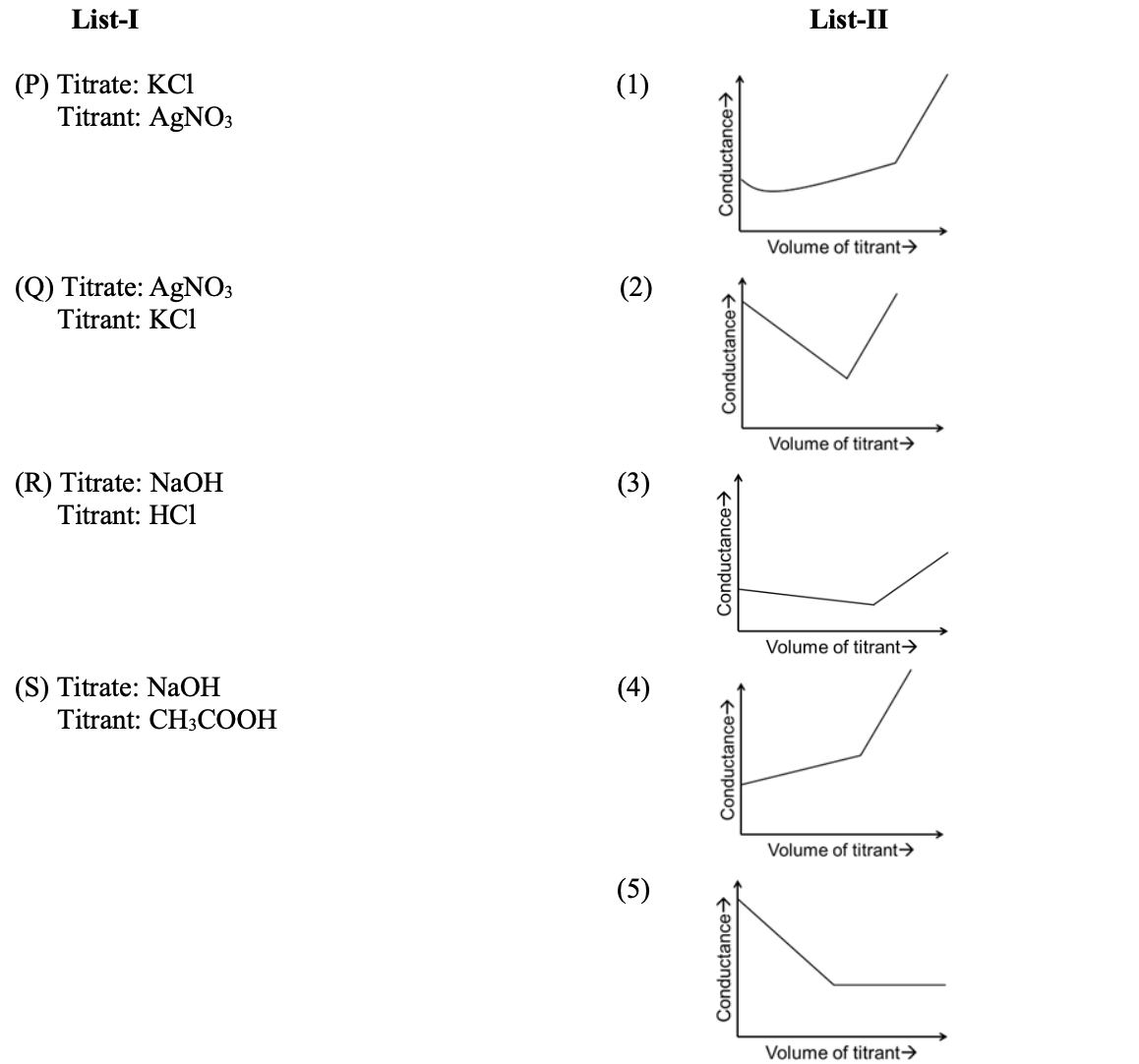
For different combinations of titrates and titrants given in List-I, the graphs of 'conductance' versus 'volume of titrant' are given in List-II. Match each entry in List-I with the appropriate entry in List-II and choose the correct option.
- A
P-4, Q-3, R-2, S-5
- B
P-2, Q-4, R-3, S-1
- C
P-3, Q-4, R-2, S-5
- D
P-4, Q-3, R-2, S-1
(P) KCl titrated with AgNO: AgCl precipitates. K stays in solution; Cl (7.6) is replaced by NO (7.2), so conductance is almost unchanged (slight decrease) before the endpoint. After endpoint, excess AgNO adds new ions, conductance rises sharply. Matches curve (3).
(Q) AgNO titrated with KCl: AgCl precipitates. Ag (6.2) is replaced by K (7.4), so conductance rises gently before endpoint, then rises more sharply when excess KCl is added. Matches curve (4).
(R) NaOH titrated with HCl: OH (19.9, very high) is replaced by Cl (7.6, much lower); conductance falls steeply. After endpoint, excess H (35.0) is added, conductance rises sharply. V-shape with steep slopes (1). Note that Na remains throughout. Matches curve (2).
(S) NaOH titrated with CHCOOH: OH (19.9) is replaced by CHCOO (4.1); conductance falls. After endpoint, excess CHCOOH is a weak electrolyte, so conductance stays roughly flat (does not rise sharply). Matches curve (5).
P-3, Q-4, R-2, S-5. Option (C).
Concept behind this question
Vapour Pressure Of A SolutionNotes, formulas and examples →More previous year questions on Vapour Pressure Of A Solution
Practice more Chemistry Section 4
Concept-wise practice with instant solutions on Fundamenthol.
Start practicing →