
JEE Main 2025 Apr 7 Shift 2, Chemistry Q7: Properties of Alkyl Halides (Halo Alkanes) & Aryl Halides (Halo Arenes)
Match List-I with List-II
| List-I Conversion | List-II Reagents, Conditions used |
|---|---|
(A) 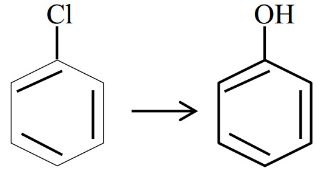 | (I) Warm, HO |
(B) 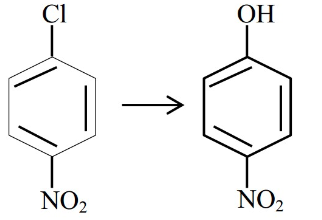 | (II) (a) NaOH, 368 K ; (b) HO |
(C) 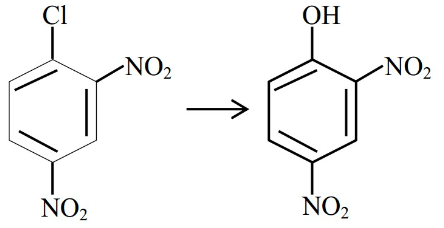 | (III) (a) NaOH, 443 K; (b) HO |
(D) 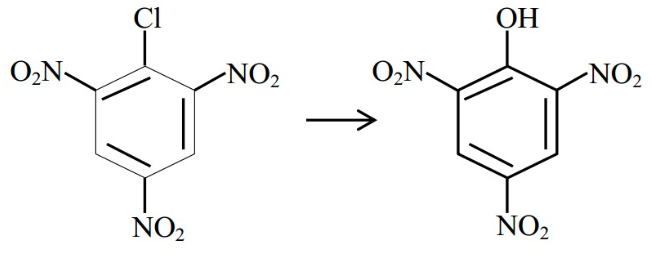 | (IV) (a) NaOH, 623 K, 300 atm ; (b) HO |
Choose the correct answer from the options given below :
- A
(A)-(II), (B)-(III), (C)-(I), (D)-(IV)
- B
(A)-(III), (B)-(IV), (C)-(II), (D)-(I)
- C
(A)-(IV), (B)-(III), (C)-(II), (D)-(I)
- D
(A)-(IV), (B)-(III), (C)-(I), (D)-(II)
Aryl halides undergo nucleophilic aromatic substitution only when the ring is activated by strongly electron-withdrawing groups such as at the ortho/para positions, since these groups stabilise the negatively charged intermediate through resonance.
Simple chlorobenzene, with no activating group, has an extremely unreactive ring; hydrolysing it to phenol requires the harshest conditions: NaOH at very high temperature and pressure (623 K, 300 atm), corresponding to (IV).
Adding one ortho group provides activation, allowing hydrolysis at a lower temperature of 443 K, corresponding to (III).
With two groups the ring is activated further, so a milder condition of 368 K suffices, corresponding to (II).
With three groups (picryl chloride), the ring is so strongly activated that simple warming with water hydrolyses the C-Cl bond, corresponding to (I).
(A)-(IV), (B)-(III), (C)-(II), (D)-(I).
Concept behind this question
Properties of Alkyl Halides (Halo Alkanes) & Aryl Halides (Halo Arenes)Notes, formulas and examples →More previous year questions on Properties of Alkyl Halides (Halo Alkanes) & Aryl Halides (Halo Arenes)
Practice more Chemistry
Concept-wise practice with instant solutions on Fundamenthol.
Start practicing →