
JEE Main 2025 Jan 23 Shift 2, Chemistry Q10: Introduction to Mechanism of Organic Reaction
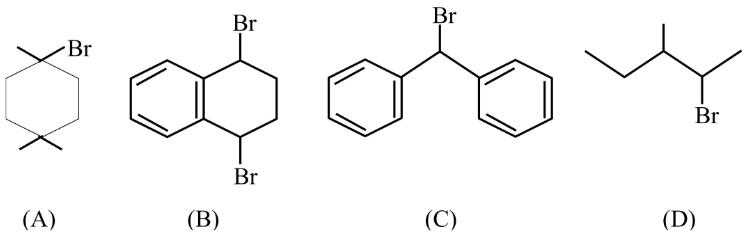
The ascending order of relative rate of solvolysis of following compounds is
- A
(D) (A) (B) (C)
- B
(C) (B) (A) (D)
- C
(D) (B) (A) (C)
- D
(C) (D) (B) (A)
Solvolysis under these conditions follows an pathway, so the rate tracks the stability of the carbocation formed on ionisation.
Ranking the cation stabilities:
(C) PhCH : the benzhydryl cation is stabilised by two phenyl groups through extended conjugation, by far the most stable.
(B) Tetralin C1 cation : a benzylic secondary cation, stabilised by one fused aromatic ring.
(A) Tertiary aliphatic cation on the cyclohexyl framework : stabilised only by hyperconjugation and inductive effects from alkyl groups, no aromatic conjugation.
(D) Secondary aliphatic cation : the least stable of the four.
Ascending order of solvolysis rate: .
Concept behind this question
Introduction to Mechanism of Organic Reaction Notes, formulas and examples →More previous year questions on Introduction to Mechanism of Organic Reaction
Practice more Chemistry
Concept-wise practice with instant solutions on Fundamenthol.
Start practicing →