
JEE Advanced 2023 Paper 2, Chemistry Section 1 Q3: Introduction to Mechanism of Organic Reaction
In the following reactions, P, Q, R, and S are the major products.
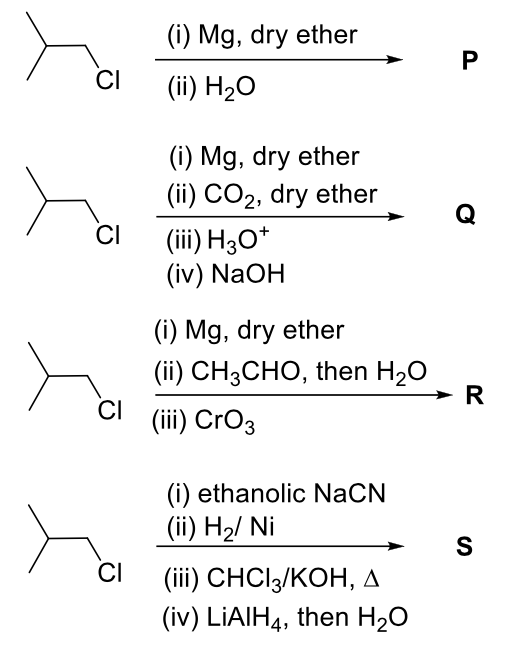
The correct statement about P, Q, R, and S is
- A
P is a primary alcohol with four carbons.
- B
Q undergoes Kolbe’s electrolysis to give an eight-carbon product.
- C
R has six carbons and it undergoes Cannizzaro reaction.
- D
S is a primary amine with six carbons.
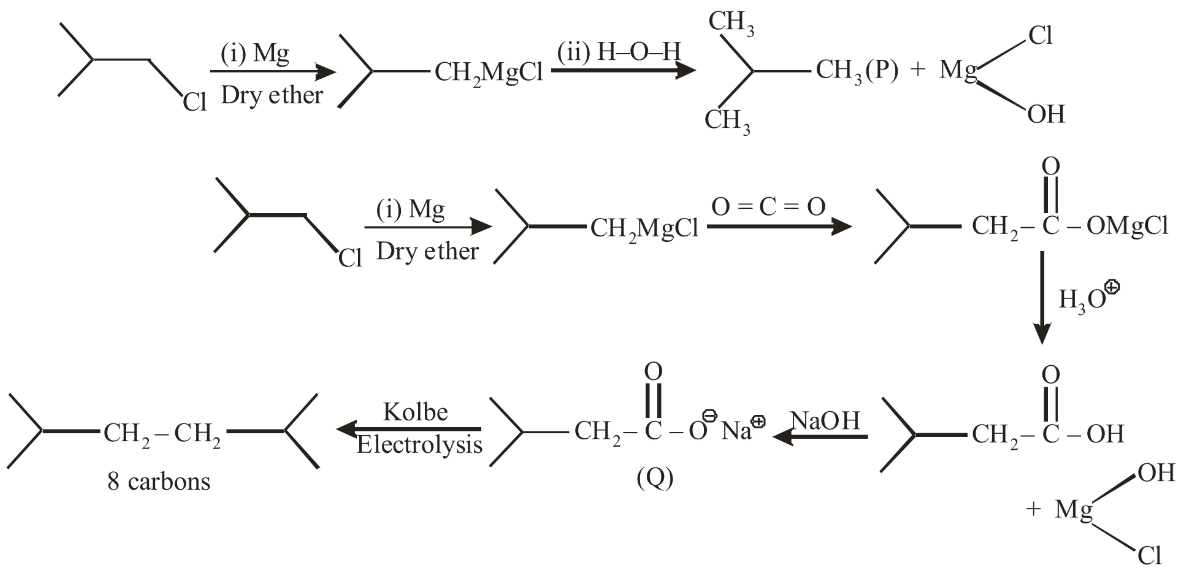
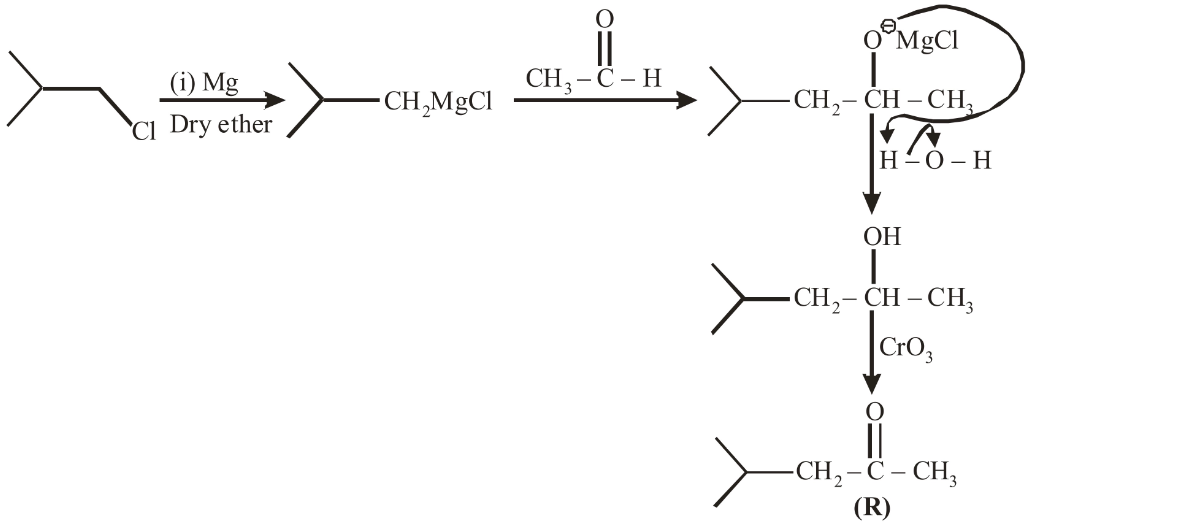
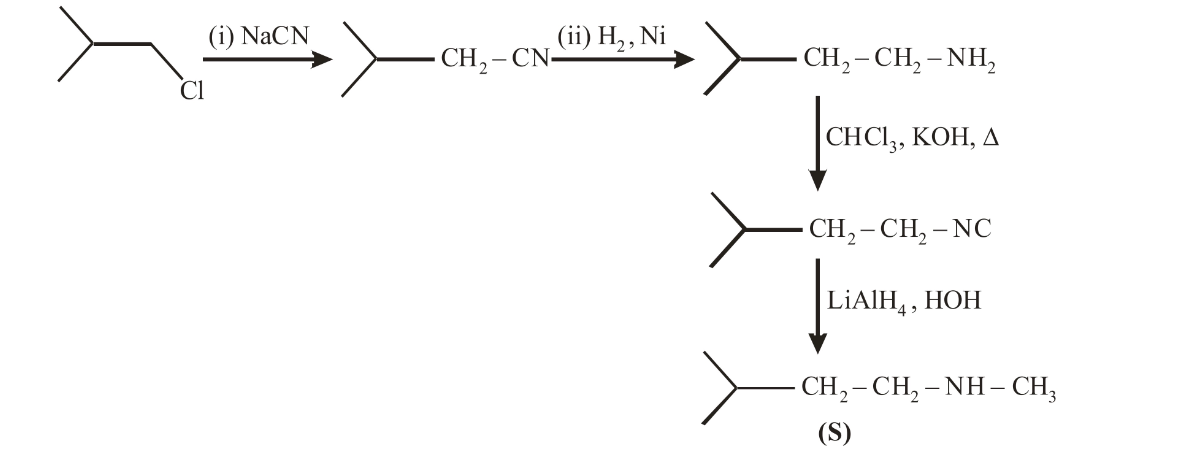
Start from isobutyl chloride in each scheme. The Grignard intermediate is .
P: Quenching the Grignard with water gives isobutane , a four-carbon alkane. It is not an alcohol, so (A) is wrong.
Q: Carboxylation with followed by acidic workup yields 3-methylbutanoic acid . After NaOH it becomes the sodium 3-methylbutanoate. Kolbe electrolysis dimerises the alkyl part: two radicals couple to give 2,5-dimethylhexane, an eight-carbon alkane. So (B) is correct.
R: Addition of the Grignard to acetaldehyde gives the secondary alcohol 4-methylpentan-2-ol after hydrolysis. Oxidation with produces 4-methylpentan-2-one , which has five carbons and possesses -hydrogens, so it does not undergo Cannizzaro reaction. (C) is wrong.
S: substitution gives the nitrile ; hydrogenation gives a primary amine . The carbylamine reaction with / converts the primary amine into an isocyanide, and reduces the isocyanide to an -methyl secondary amine . Hence S is a secondary amine, not a primary amine, so (D) is wrong.
Correct statement is (B).
Concept behind this question
Introduction to Mechanism of Organic Reaction Notes, formulas and examples →More previous year questions on Introduction to Mechanism of Organic Reaction
Practice more Chemistry Section 1
Concept-wise practice with instant solutions on Fundamenthol.
Start practicing →