
JEE Main 2026 Apr 8 Shift 2, Chemistry Q13: Introduction to Mechanism of Organic Reaction
The major product of which of the following reaction is not obtained by rearrangement reaction?
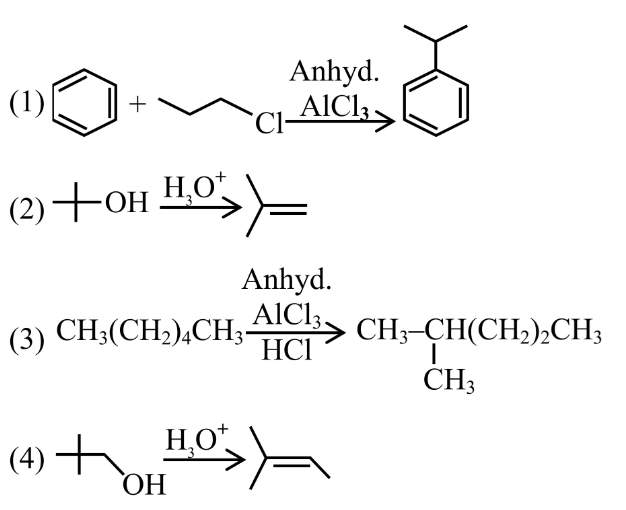
- A
1
- B
2
- C
3
- D
4
Test each option for whether the major product requires a carbocation rearrangement (hydride or methyl shift) or skeletal isomerisation.
Option (1): Friedel–Crafts alkylation of benzene with -propyl chloride. The initially formed propyl cation rearranges via a hydride shift to the more stable isopropyl cation, so cumene (not -propylbenzene) is the major product — rearrangement.
Option (2): 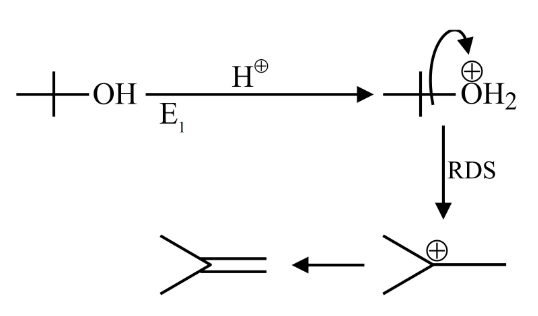 Acid-catalysed dehydration of a alcohol. The protonation–loss of water gives a stable carbocation that directly loses a -H to give the alkene — no skeletal rearrangement.
Option (3): AlCl/HCl with -hexane drives chain isomerisation to the branched 2-methylpentane — rearrangement.
Option (4): Acid dehydration where the initial cation undergoes a hydride/methyl shift before -elimination, giving a rearranged alkene — rearrangement.
The product of reaction (2) is obtained without rearrangement.
Concept behind this question
Introduction to Mechanism of Organic Reaction Notes, formulas and examples →More previous year questions on Introduction to Mechanism of Organic Reaction
Practice more Chemistry
Concept-wise practice with instant solutions on Fundamenthol.
Start practicing →