
JEE Main 2025 Jan 28 Shift 2, Chemistry Q11: Bonding Of Co-ordination Compounds
Match List-I with List-II.
| List-I (Complex) | List-II (Hybridisation of central metal ion) |
|---|---|
| (A) | (I) |
| (B) | (II) |
| (C) | (III) |
| (D) | (IV) |
Choose the correct answer from the options given below :
- A
(A)-(I), (B)-(IV), (C)-(III), (D)-(II)
- B
(A)-(III), (B)-(II), (C)-(I), (D)-(IV)
- C
(A)-(I), (B)-(II), (C)-(III), (D)-(IV)
- D
(A)-(III), (B)-(IV), (C)-(I), (D)-(II)
Hybridisation is determined by the metal's d-electron count and the field strength of the ligand:
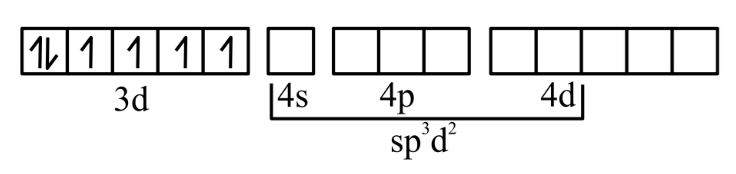
(A) : is , is a weak-field ligand so no pairing. Outer-orbital complex uses orbitals giving hybridisation (octahedral, paramagnetic). (A)(III).
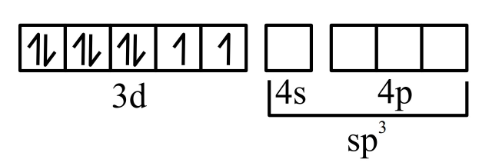
(B) : is , is weak field, giving hybridisation (tetrahedral, paramagnetic). (B)(II).
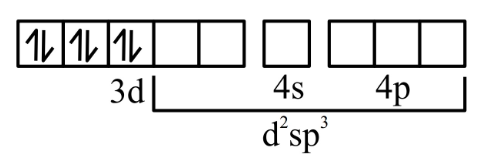
(C) : () with strong-field ligands pairs electrons and uses inner orbitals, hybridisation (octahedral, diamagnetic). (C)(I).
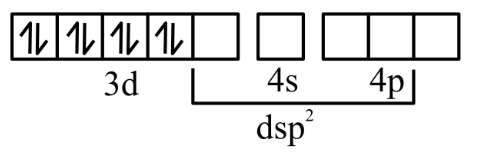
(D) : () with strong-field pairs the electrons in leaving one orbital free, hybridisation (square planar, diamagnetic). (D)(IV).
(A)-(III), (B)-(II), (C)-(I), (D)-(IV).
Concept behind this question
Bonding Of Co-ordination CompoundsNotes, formulas and examples →More previous year questions on Bonding Of Co-ordination Compounds
Practice more Chemistry
Concept-wise practice with instant solutions on Fundamenthol.
Start practicing →