
JEE Main 2026 Apr 4 Shift 2, Chemistry Q18: Carbohydrates
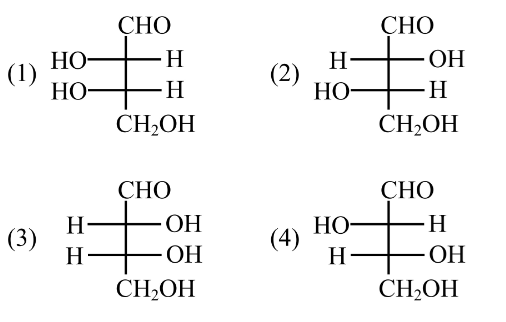
A D-aldotetrose on oxidation with concentrated HNO resulted in optically inactive dicarboxylic acid. The structure of the D-aldotetrose is:
- A
1
- B
2
- C
3
- D
4
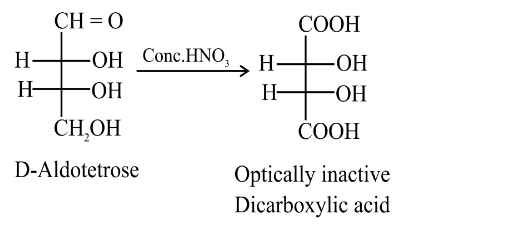
Concentrated HNO oxidizes both the CHO and the terminal CHOH of an aldose to COOH, giving an aldaric (saccharic) acid.
The dicarboxylic acid is optically inactive only if it has an internal plane of symmetry — i.e., it is a meso compound.
For a D-aldotetrose Fischer projection (CHO at top, CHOH at bottom, two chiral OH groups in between), oxidation to a tetrahedral diacid:
Erythrose (both OH on the right, "H–OH, H–OH"): both ends become COOH; the resulting tartaric-acid-like structure has the two OH groups on the same side, giving a meso-tartaric-acid type with internal symmetry optically inactive.
Threose (OHs on opposite sides) would give an optically active diacid.
The aldotetrose is D-erythrose — Fischer projection with both OH groups on the right (option 3).
Concept behind this question
CarbohydratesNotes, formulas and examples →More previous year questions on Carbohydrates
Practice more Chemistry
Concept-wise practice with instant solutions on Fundamenthol.
Start practicing →