
JEE Main 2026 Apr 5 Shift 1, Chemistry Q14: Mechanism of Some Important Reactions of Alkenes
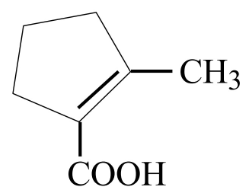
"P" is a hydrocarbon of molecular formula . On ozonolysis, "P" forms "Q". "Q" on treatment with alkali under reflux condition produces "R", which on treatment with gives a yellow precipitate. Acidification of the solution gives "S". The structure of "S" is given below :
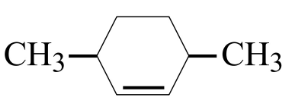
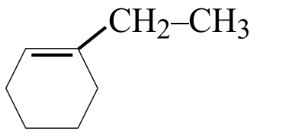
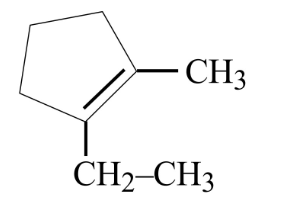
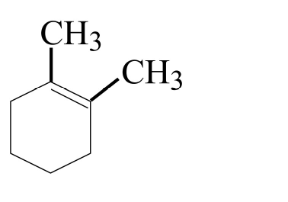
The correct structure of "P" is
- A
- B
- C
- D
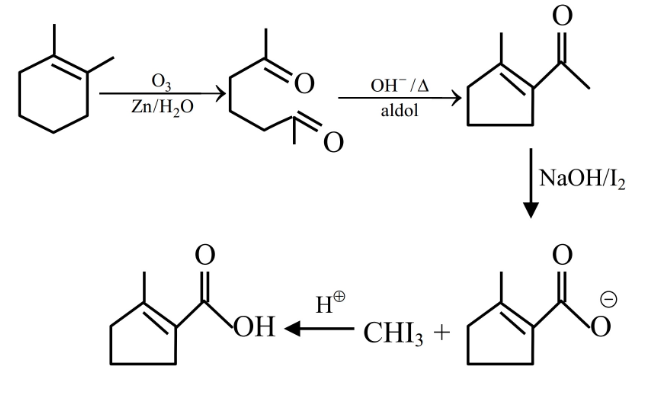
Work backward from S. The ring in S is five-membered with one alkene-COOH and one alkene-CH. So R is a cyclopentenyl methyl ketone (formed by intramolecular aldol condensation of Q) that on haloform reaction (I/NaOH) loses the methyl group as CHI and, after acidification, leaves the carboxylic acid S.
This means Q is a 1,6-dicarbonyl (a diketone or a keto-aldehyde) capable of intramolecular aldol cyclisation to the five-membered ring. Ozonolysis of P must produce that 1,6-dicarbonyl.
The precursor that cleanly fits is 1,2-dimethylcyclohex-1-ene: ozonolysis cleaves the ring at the internal alkene, generating a 1,6-diketone (with both carbonyls -substituted by methyls). Intramolecular aldol condensation gives the methylcyclopentenyl ketone R, then haloform/acidification delivers S.
Therefore P is 1,2-dimethylcyclohex-1-ene.
Concept behind this question
Mechanism of Some Important Reactions of AlkenesNotes, formulas and examples →More previous year questions on Mechanism of Some Important Reactions of Alkenes
Practice more Chemistry
Concept-wise practice with instant solutions on Fundamenthol.
Start practicing →