
JEE Advanced 2025 Paper 2, Chemistry Section 2 Q3: Preparation of Amines
For the reaction sequence given below, the correct statement(s) is(are)

- A
Both X and Y are oxygen containing compounds.
- B
Y on heating with CHCl/KOH forms isocyanide.
- C
Z reacts with Hinsberg's reagent.
- D
Z is an aromatic primary amine.
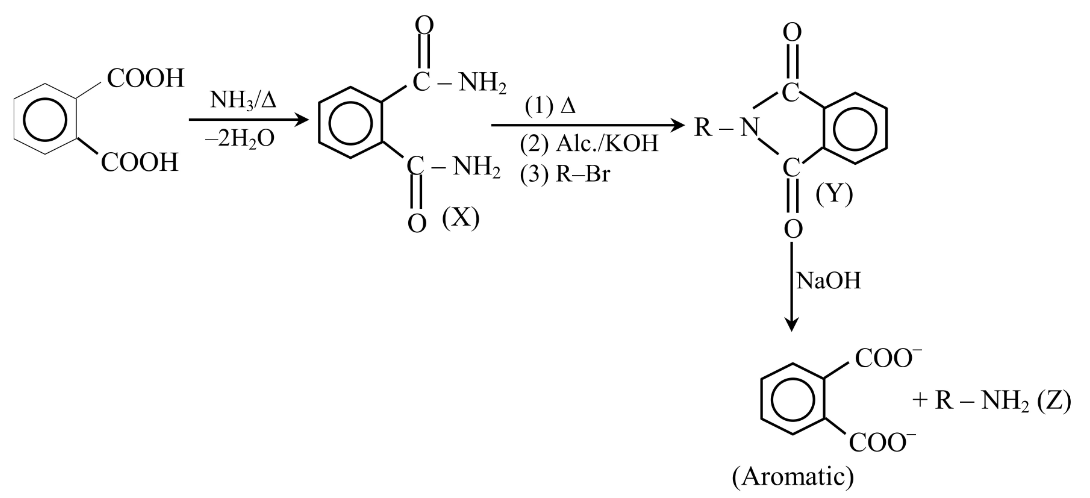
Trace the sequence:
1,2,3,4-Tetrahydronaphthalene is oxidised by hot acidic KMnO at the benzylic ring carbons to give phthalic acid (benzene-1,2-dicarboxylic acid). With NH and heat (loss of 2 HO), this becomes phthalimide. Hence X = phthalimide (contains C=O).
Phthalimide treated with strong heat, ethanolic KOH and R-Br gives N-alkyl phthalimide (this is the alkylation step of the Gabriel synthesis). Hence Y = N-alkyl phthalimide (also contains C=O groups).
NaOH hydrolysis of N-alkyl phthalimide releases the disodium phthalate (aromatic compound) and a primary amine R-NH as Z.
Now assess the statements:
(A) Both X (phthalimide) and Y (N-alkyl phthalimide) contain oxygen. Correct.
(B) The carbylamine reaction (CHCl/KOH giving isocyanide) requires a primary amine. Y has no N-H, so it does not undergo the carbylamine test. Incorrect.
(C) Z is a primary amine and reacts with Hinsberg's reagent (PhSOCl) to give an alkali-soluble sulphonamide. Correct.
(D) Z = R-NH is a primary alkyl amine (R came from R-Br), not an aromatic amine. Incorrect.
Correct options are (A) and (C).
Concept behind this question
Preparation of AminesNotes, formulas and examples →More previous year questions on Preparation of Amines
Practice more Chemistry Section 2
Concept-wise practice with instant solutions on Fundamenthol.
Start practicing →