
JEE Advanced 2025 Paper 2, Chemistry Section 2 Q4: Properties and Important Reactions of Aldehydes & Ketones
For the reaction sequence given below, the correct statement(s) is(are)
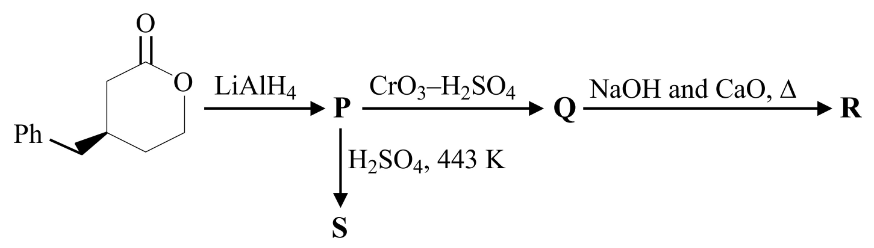
- A
P is optically active.
- B
S gives Bayer's test.
- C
Q gives effervescence with aq. NaHCO.
- D
R is an alkyne.
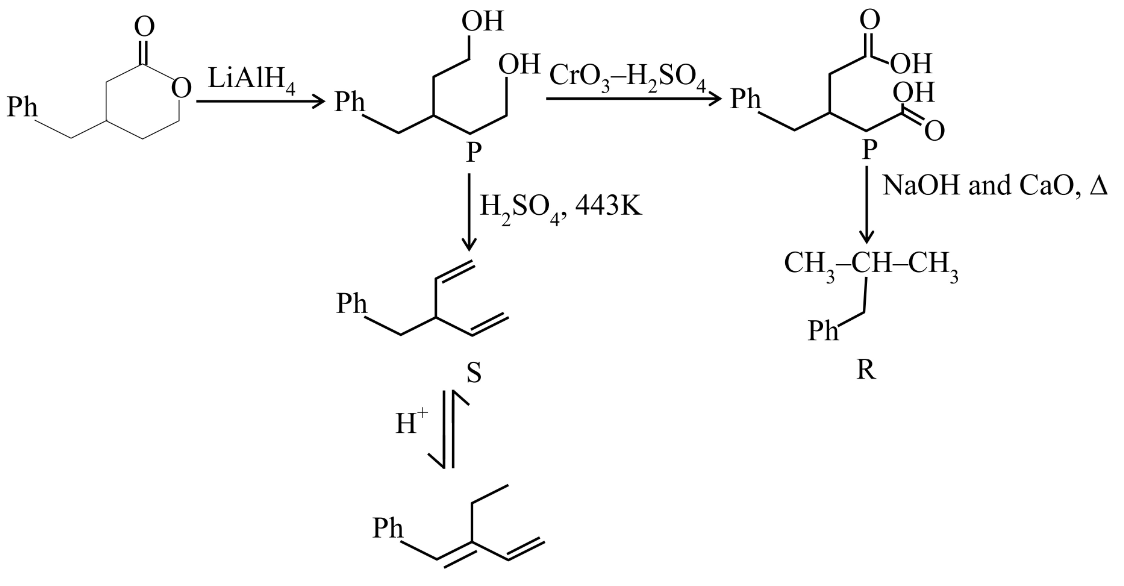
The starting -lactone (six-membered ring) bearing a -CH-Ph group at C-4 (chirality centre) is reduced by LiAlH to a diol, since lactone diol. The product P is Ph-CH-CH(-)-CH-CH-CH-OH with an additional -CH-OH (a 1,5-diol with the benzyl branch on C-2 of the chain).
(A) Although the starting lactone was chiral at the carbon bearing -CHPh, in P that same carbon now has two identical chains terminating in -CHOH on either side (after the lactone ring opens). The stereocentre is lost, so P is not optically active. Incorrect.
(B) Dehydration of P with HSO at 443 K eliminates water from both alcohol groups, producing a diene S. A diene decolourises cold dilute alkaline KMnO (Baeyer's test). Correct.
(C) Oxidation of P with CrO-HSO (Jones oxidation) converts both primary alcohols to carboxylic acids, giving a dicarboxylic acid Q. Carboxylic acids give effervescence (CO) with aq. NaHCO. Correct.
(D) Decarboxylation of the dicarboxylic acid Q with NaOH/CaO (soda-lime) removes both -COOH groups as CO, leaving an alkane (specifically isopropylbenzene-type / cumene-like alkylbenzene, not an alkyne). Incorrect.
Correct options are (B) and (C).
Concept behind this question
Properties and Important Reactions of Aldehydes & Ketones Notes, formulas and examples →More previous year questions on Properties and Important Reactions of Aldehydes & Ketones
Practice more Chemistry Section 2
Concept-wise practice with instant solutions on Fundamenthol.
Start practicing →