
JEE Main 2025 Apr 7 Shift 2, Chemistry Q25: Properties and Important Reactions of Aldehydes & Ketones
Identify the structure of the final product (D) in the following sequence of the reactions :
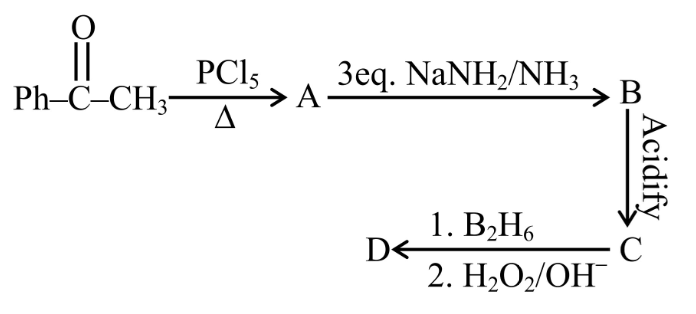
Total number of sp hybridised carbon atoms in product D is.
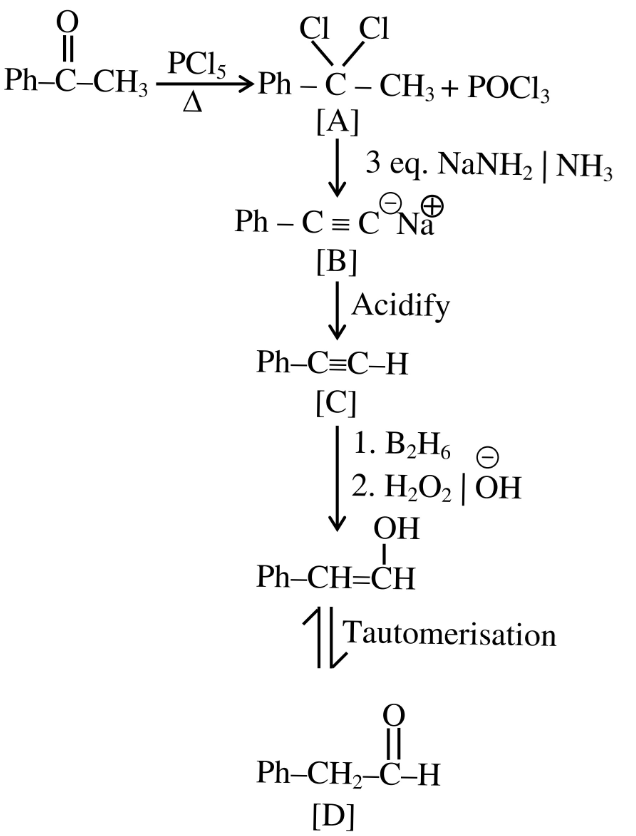
Treating acetophenone (Ph-CO-CH) with PCl converts the carbonyl into a geminal dichloride: A = Ph-CCl-CH.
Reacting A with excess (3 equivalents) of sodium amide in liquid ammonia carries out a double dehydrohalogenation followed by deprotonation, converting the gem-dihalide into the terminal sodium alkynide: B = Ph-CC-Na.
Acidifying B simply protonates the alkynide to give the terminal alkyne: C = Ph-CCH (phenylacetylene).
Hydroboration of the alkyne with BH followed by oxidation with alkaline HO adds "H-OH" across the triple bond with anti-Markovnikov regiochemistry, initially giving an enol, Ph-CH=CH-OH, which immediately tautomerises to the more stable carbonyl form: D = Ph-CH-CHO (2-phenylacetaldehyde).
Counting sp carbons in D: the six aromatic ring carbons of the phenyl group are all sp, and the aldehyde carbon (C=O) is also sp, while the -CH- carbon is sp. This gives sp hybridised carbons.
Concept behind this question
Properties and Important Reactions of Aldehydes & Ketones Notes, formulas and examples →More previous year questions on Properties and Important Reactions of Aldehydes & Ketones
Practice more Chemistry
Concept-wise practice with instant solutions on Fundamenthol.
Start practicing →