
JEE Main 2025 Jan 29 Shift 1, Chemistry Q25: Properties and Important Reactions of Aldehydes & Ketones
Consider the following reaction sequence :
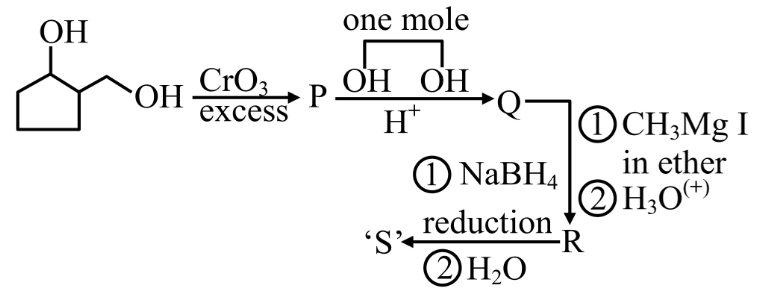
0.1 mole of compound 'S' will weigh _____ g.
(Given molar mass in g mol C: 12, H: 1, O: 16)
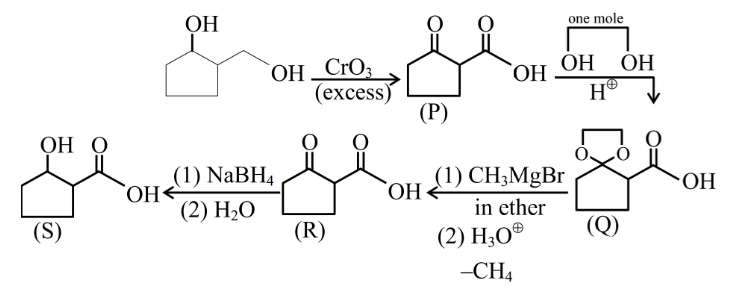
Track the transformations step by step on the cyclopentane core:
P: Excess oxidises both the secondary alcohol on the ring and the primary side-chain. The primary alcohol is oxidised all the way to a carboxylic acid, while the ring secondary alcohol becomes a ketone. P is therefore a 2-oxocyclopentane-1-carboxylic acid type compound.
Q: Under acid catalysis, intramolecular condensation between the keto and acid functions yields a bicyclic keto-lactone (one mole acid catalyst, one elimination of water).
R: /ether followed by adds a methyl to the more reactive carbonyl, the lactone opening to give a hydroxy-ester / hydroxy-keto intermediate (with loss of from any acidic OH proton on the Grignard's first equivalent).
S: reduces the remaining ketone to a secondary alcohol, leaving an open-chain or cyclopentane derivative bearing an , an and an ester carbonyl as appropriate. S has molecular formula corresponding to a molar mass of .
Mass of 0.1 mol of S
Concept behind this question
Properties and Important Reactions of Aldehydes & Ketones Notes, formulas and examples →More previous year questions on Properties and Important Reactions of Aldehydes & Ketones
Practice more Chemistry
Concept-wise practice with instant solutions on Fundamenthol.
Start practicing →