
JEE Main 2026 Apr 4 Shift 1, Chemistry Q14: Mechanism of Some Important Reactions of Alkenes
An alkene (X) on ozonolysis followed by reduction gives following products.
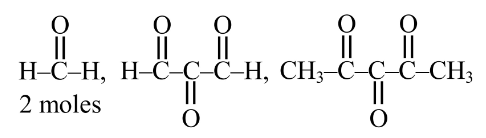
The alkene (X) is :
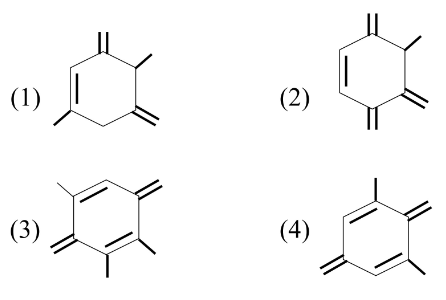
- A
1
- B
2
- C
3
- D
4
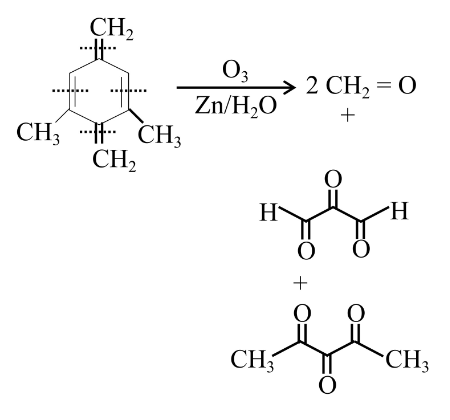
Reductive ozonolysis cleaves each C=C bond and replaces it with two C=O groups. Working backwards from the products, identify the carbon skeletons that pair up across the original double bonds.
Two moles of indicate two terminal groups attached to the ring (each piece becomes + ring ketone fragment).
The fragment (a -tricarbonyl with H termini) arises when three adjacent ring carbons, each unsubstituted at the ring junction, are each part of a C=C cleavage.
The fragment similarly arises from three adjacent ring carbons each carrying a methyl group.
Reassembling: a six-membered ring with alternating C=C bonds in the ring, two exocyclic groups, and two methyl substituents in positions matching the tricarbonyl with methyl ends. This is the structure depicted in option (4).
Concept behind this question
Mechanism of Some Important Reactions of AlkenesNotes, formulas and examples →More previous year questions on Mechanism of Some Important Reactions of Alkenes
Practice more Chemistry
Concept-wise practice with instant solutions on Fundamenthol.
Start practicing →