
JEE Main 2026 Apr 5 Shift 1, Chemistry Q17: Properties of Alcohol
Consider compounds A, B and C with the following structural formulae:
A = (pentan-1-ol)
B = (pent-1-ene)
C = (butane-1,3-diol)
For the conversion of B from A, reagent (D) required is _________ and structural formula of product (E) obtained when C undergoes same reaction using excess reagent (D) is ______
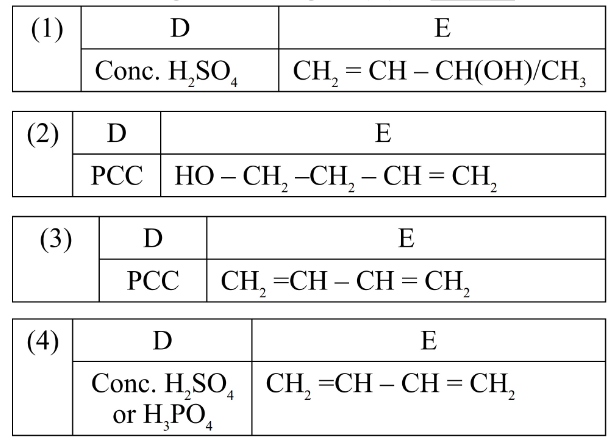
- A
1
- B
2
- C
3
- D
4
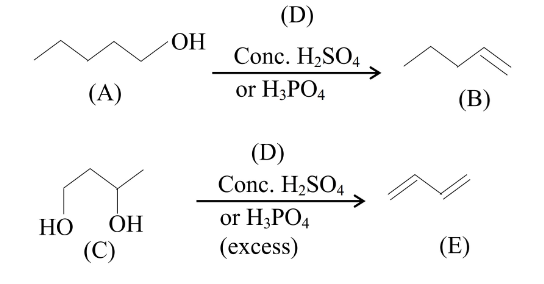
Conversion of pentan-1-ol to pent-1-ene is an acid-catalysed dehydration. PCC oxidises, it does not dehydrate, so (D) is concentrated HSO (or HPO).
Butane-1,3-diol, on heating with excess concentrated acid, loses two molecules of water to give a conjugated diene. The two hydroxyls are on C1 and C3, so both eliminations together yield 1,3-butadiene: .
Hence D is conc. HSO (or HPO) and E is 1,3-butadiene.
Concept behind this question
Properties of AlcoholNotes, formulas and examples →More previous year questions on Properties of Alcohol
Practice more Chemistry
Concept-wise practice with instant solutions on Fundamenthol.
Start practicing →