
JEE Advanced 2023 Paper 2, Chemistry Section 4 Q4: Diazonium Salt
PARAGRAPH II
A trinitro compound, -tris-(4-nitrophenyl) benzene, on complete reaction with an excess of Sn/HCl gives major product, which on treatment with an excess of NaNO/HCl at C provides P as the product. P, upon treatment with excess of HO at room temperature, gives the product Q. Bromination of Q in aqueous medium furnishes the product R. The compound P upon treatment with an excess of phenol under basic conditions gives the product S.
The molar mass difference between compounds Q and R is g mol and between compounds P and S is g mol.
Q2. The total number of carbon atoms and heteroatoms present in one molecule of S is _____.
[Use: Molar mass in g mol: H , C , N , O , Br , Cl . Atoms other than C and H are considered as heteroatoms.]
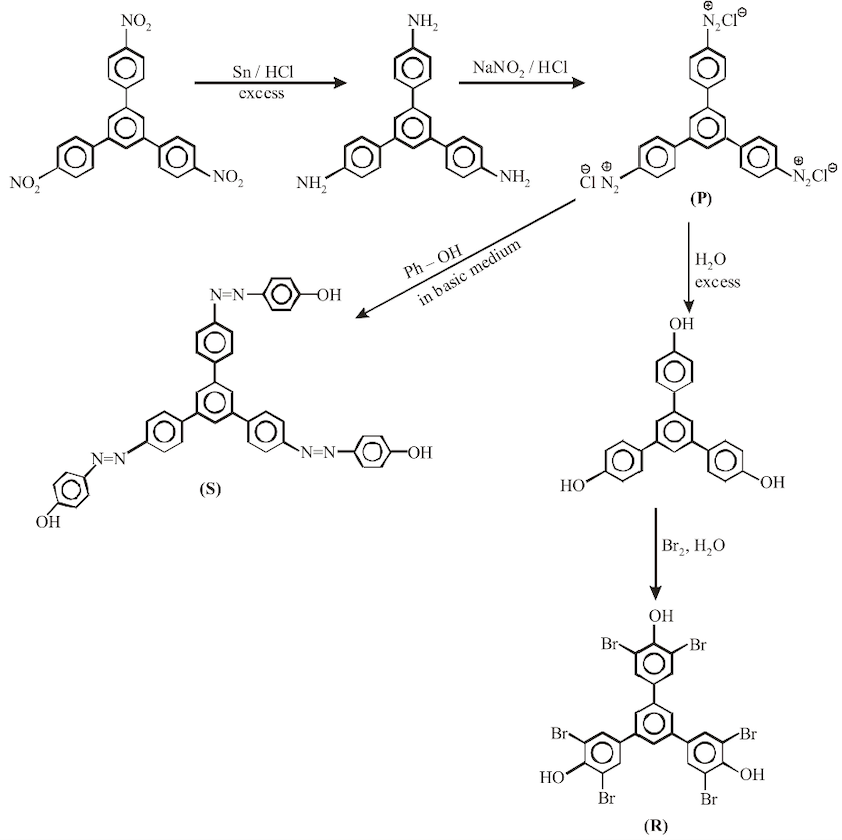
Under basic conditions, each diazonium group of P couples with phenol at the para position of phenol (azo coupling). All three diazonium groups react, giving an aromatic azo dye S:
-trisbenzene.
Structurally, S has a central benzene ring (6 C) and three identical arms of the form .
Carbon count. Central ring contributes . Each arm has carbons; three arms add . Total .
Heteroatom count. Each arm has nitrogens (azo ) and oxygen (phenolic ), giving heteroatoms per arm. Three arms contribute heteroatoms.
Total of and heteroatoms .
Concept behind this question
Diazonium Salt Notes, formulas and examples →More previous year questions on Diazonium Salt
Practice more Chemistry Section 4
Concept-wise practice with instant solutions on Fundamenthol.
Start practicing →