
JEE Advanced 2023 Paper 2, Chemistry Section 4 Q3: Diazonium Salt
PARAGRAPH II
A trinitro compound, -tris-(4-nitrophenyl) benzene, on complete reaction with an excess of Sn/HCl gives major product, which on treatment with an excess of NaNO/HCl at C provides P as the product. P, upon treatment with excess of HO at room temperature, gives the product Q. Bromination of Q in aqueous medium furnishes the product R. The compound P upon treatment with an excess of phenol under basic conditions gives the product S.
The molar mass difference between compounds Q and R is g mol and between compounds P and S is g mol.
Q1. The number of heteroatoms present in one molecule of R is _____.
[Use: Molar mass (in g mol): H , C , N , O , Br , Cl . Atoms other than C and H are considered as heteroatoms.]
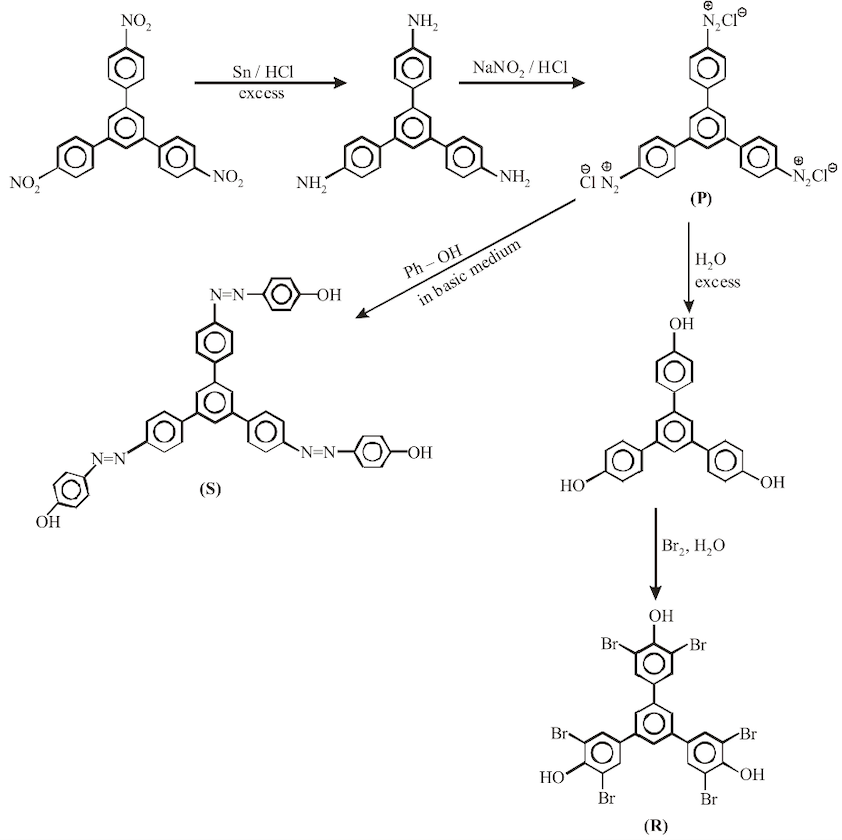
Trace the transformations starting from -tris(4-nitrophenyl)benzene.
(i) Excess Sn/HCl reduces each to , giving -tris(4-aminophenyl)benzene.
(ii) NaNO/HCl at C diazotises all three groups, so P is the trichloride salt of -tris(4-diazoniumphenyl)benzene.
(iii) Excess HO converts each to , giving Q -tris(4-hydroxyphenyl)benzene.
(iv) Bromination in water on each phenol ring goes to the two activated ortho positions, installing Br on each of the three outer rings, so R has Br atoms together with the three groups.
Heteroatom count in R. Atoms other than C and H are heteroatoms.
oxygens (from ) bromines heteroatoms.
number of heteroatoms in R .
Consistency check on the molar mass difference : each on an aromatic ring is replaced by , a net change of per substitution. With substitutions, g mol, as stated.
Concept behind this question
Diazonium Salt Notes, formulas and examples →More previous year questions on Diazonium Salt
Practice more Chemistry Section 4
Concept-wise practice with instant solutions on Fundamenthol.
Start practicing →