
JEE Advanced 2022 Paper 1, Chemistry Section 2 Q5: Diazonium Salt
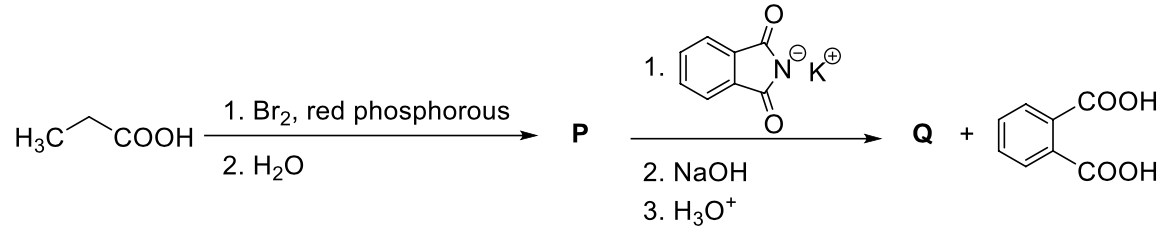
Considering the reaction sequence given below, the correct statement(s) is(are)
- A
P can be reduced to a primary alcohol using NaBH.
- B
Treating P with conc. NHOH solution followed by acidification gives Q.
- C
Treating Q with a solution of NaNO in aq. HCl liberates N.
- D
P is more acidic than CHCHCOOH.
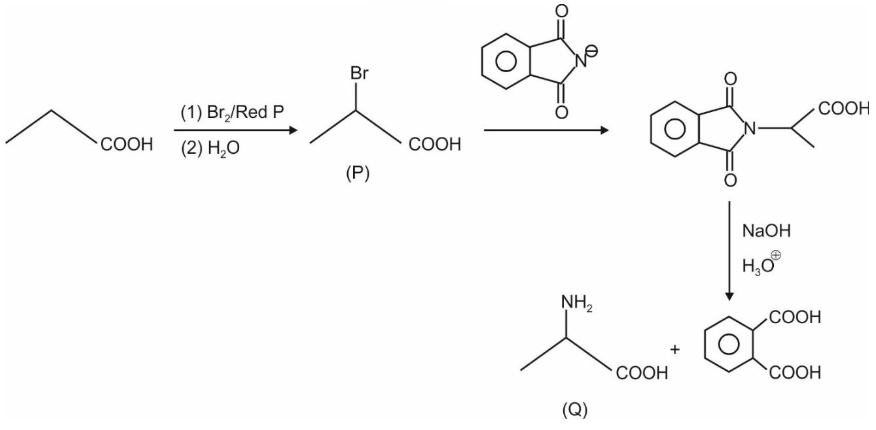
Step 1 is the Hell-Volhard-Zelinsky (HVZ) reaction: -bromination of propanoic acid gives P = 2-bromopropanoic acid (CHCHBrCOOH).
The Gabriel phthalimide synthesis then converts the alkyl halide centre to a primary amine. After base hydrolysis and acid workup, Q = alanine (2-aminopropanoic acid, CHCH(NH)COOH), with phthalic acid as the byproduct.
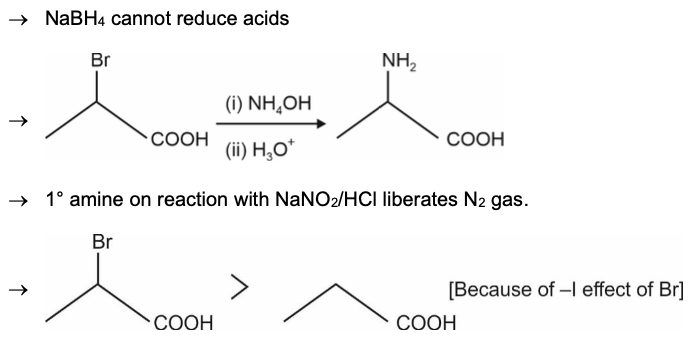
(A) NaBH is too weak to reduce carboxylic acids; P retains its –COOH group. Wrong.
(B) Treating an -haloacid with concentrated ammonia followed by workup also gives the -amino acid (Q) via SN2 displacement of Br by NH. Correct.
(C) Alanine has a primary aliphatic amine. With NaNO/HCl at low temperature, primary aliphatic amines give an unstable diazonium salt that decomposes to liberate N. Correct.
(D) The electron-withdrawing I effect of the -Br stabilises the conjugate base of P, making 2-bromopropanoic acid more acidic than propanoic acid. Correct.
Concept behind this question
Diazonium Salt Notes, formulas and examples →More previous year questions on Diazonium Salt
Practice more Chemistry Section 2
Concept-wise practice with instant solutions on Fundamenthol.
Start practicing →